Project overview
The challenge
- The legacy monolithic architecture struggled to handle the increasing load of real-time availability checks and booking requests, leading to performance bottlenecks during peak travel seasons.
- Synchronizing inventory and pricing across multiple disparate systems (RTX, Core, V1) and databases (MongoDB, MSSQL) resulted in data inconsistencies and overbooking risks.
- Onboarding new B2B partners required significant custom development due to rigid API structures, slowing down business expansion and partner integration.
- A failure in one module (e.g., search) would often cascade and bring down the entire booking system, affecting revenue and partner trust.
- Integrating modern JSON-based REST APIs with legacy SQL Server-based backends required complex middleware and data transformation layers.
BoosterBC's legacy hotel platform was a monolith that scaled poorly and coupled booking transactions directly to inventory queries — every peak-season surge risked cascading failures. The assignment: re-architect from the ground up into a distributed microservices ecosystem that could absorb multi-provider inventory feeds, serve millions of B2B API requests with high availability, and stay online while the migration happened.
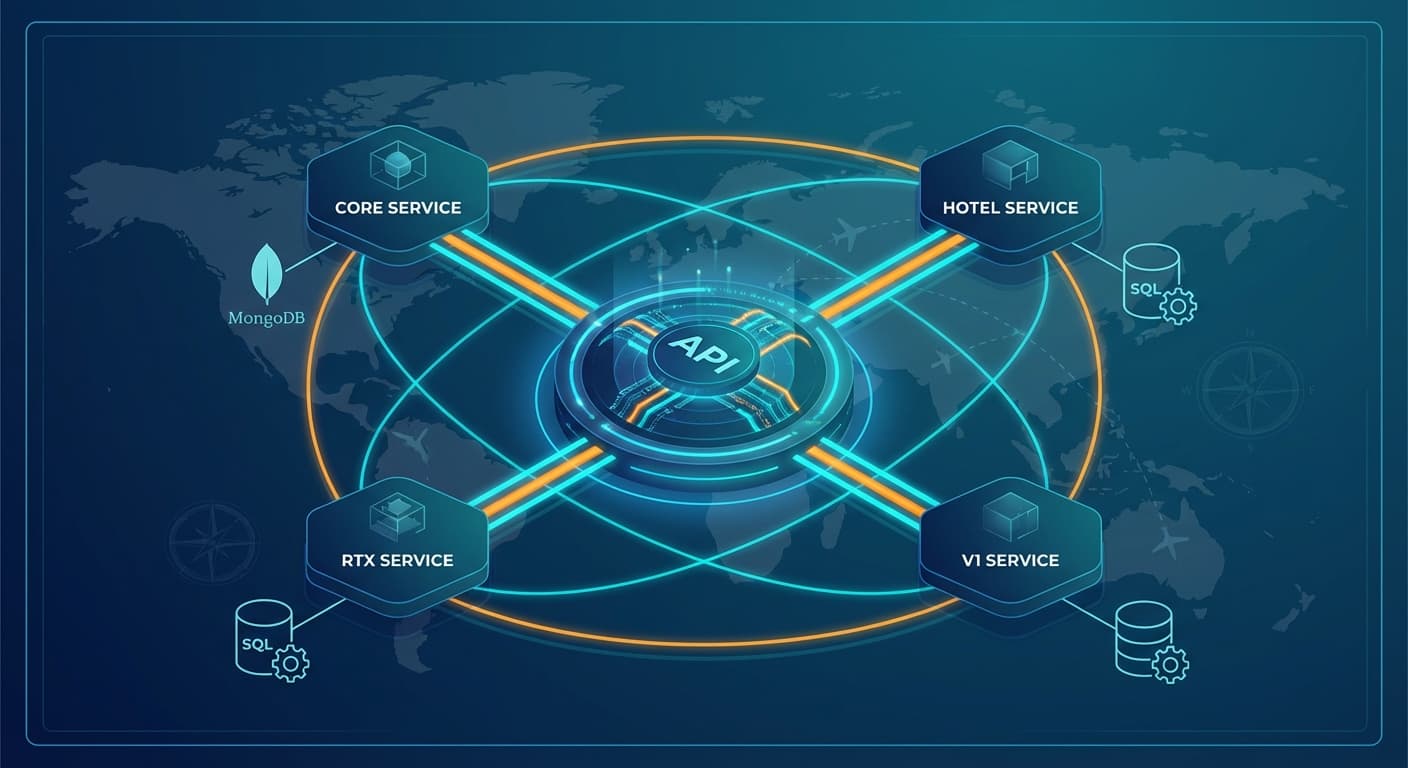
The system decouples into four independent services — Core, Hotel, RTX (real-time exchange), and V1 legacy adapter — each owning its data store. MongoDB handles high-throughput document storage for hotel content and event logs; MSSQL preserves transactional integrity for bookings and legacy system compatibility. An event-driven RTX layer keeps data consistent across the two stores without coupling their write paths.
Redis caching on the search path eliminates redundant provider API calls, delivering sub-2s response times under load. Centralized error tracking surfaces failures in real time before B2B partners notice them. The result: 99.9% uptime across a globally distributed hotel inventory, with individual services deployable and scalable independently.
Technical architecture
Core API (api.travelbeds.pro): The central orchestration service handling authentication, booking management, and suggestion engines. It serves as the primary entry point for general platform operations.
Hotel API (api.hotels.travelbeds.pro): A specialized microservice dedicated to serving static hotel data (content, images, facilities) and real-time availability. Optimized for high read throughput using MongoDB.
RTX API (api.rtx.travelbeds.pro): The Real-Time Exchange service acting as a bridge between modern MongoDB storage and legacy MSSQL systems. It handles complex data synchronization and transformation tasks.
V1 API (api.rtx.travelbedsV1.pro): A compatibility layer ensuring backward compatibility for legacy partners while gradually migrating traffic to the new microservices architecture.
Hybrid Data Storage: Utilizes MongoDB for flexible, high-speed document storage (hotel content, logs) and MSSQL for transactional integrity and legacy system compatibility.
Key challenges & solutions
Distributed Data Consistency
Implemented an event-driven synchronization mechanism within the RTX API. When a booking occurs, an event triggers a reliable transaction to update MSSQL, ensuring eventual consistency without blocking the user experience.
High-Performance Search & Availability
Deployed Redis caching layers for frequently accessed static data and availability results. Optimized MongoDB indexes and implemented geospatial queries for location-based searches, reducing response times by 60%.
Error Tracking in Distributed Systems
Developed a centralized error handling module (nodeMailer integration) that captures stack traces, request context (body, query, headers), and user details, sending real-time alerts to the development team.
Legacy Protocol Adaptation
Built a transformation middleware in api.rtx.travelbedsV1.pro that normalizes legacy responses into standard JSON format, allowing the frontend to consume both new and old APIs transparently.
Secure Multi-Tenant Access
Implemented API Key authentication middleware across all services. Each request is validated against a secure registry, and specific routes (e.g., /admin) are protected with additional role-based access controls.
Impact & results
99.9% System Availability achieved by decoupling services, ensuring failures in legacy modules don't impact the core booking engine
50% Faster Partner Onboarding due to standardized API gateway and clear separation of concerns
Real-Time Reporting enabled by hybrid MongoDB/MSSQL architecture for operational dashboards and financial auditing
Scalable Infrastructure allowing independent scaling of high-traffic components like the Hotel API
Seamless Legacy Integration providing backward compatibility while migrating to modern microservices
Key features
- Distributed microservices architecture
- Hybrid MongoDB/MSSQL data storage
- Real-time data synchronization (RTX)
- High-performance Redis caching
- Centralized error tracking & alerting
- Secure multi-tenant B2B access